
We use cookies on this site to enhance your experience.
By selecting “Accept” and continuing to use this website, you consent to the use of cookies.
This project interrogates perceptions about people experiencing homelessness as inherently deviant and dangerous, and build a new narrative premised on knowledge sharing and enhancing community resiliency.
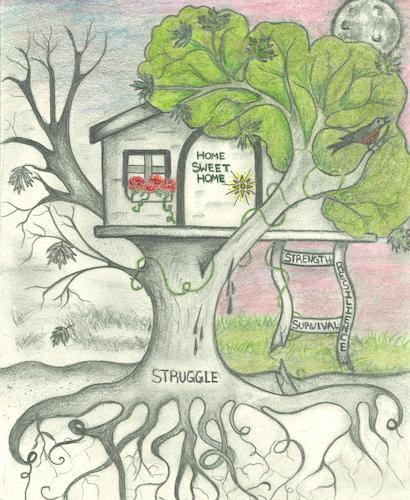
This tree depicts the root causes of homelessness and the effort to becoming housed. It is a maple tree, one that provides so much joy and bounty in its beauty, shade, and sap. The sweetness of the tree is on its inside. The tree has so much to offer and is valuable just by the nature of what it is. So too are all people worthy and important simply by being who they are.
The tree is divided in two. One side shows what can happen if people are provided with the care, support, and community they need to become stably housed. There is colour and brightness in the lives of people who have the opportunity to find and maintain housing. The other side is a decaying tree and represents what happens when people are not given the tools and resources to flourish. The world is darker and it is difficult to find hope beyond daily survival.
The story of homelessness begins at the roots of the tree – the foundation for the journey to come. For many people who are homeless their lives are rooted in oppression and marginalization. Experiences of generational poverty, discrimination based on gender, race, ability, or sexuality, mental health challenges, relationship breakdown and intimate partner violence, and childhood trauma are some of roots that can lead to homelessness. For Indigenous Peoples, colonization, represented here by dry land, does not provide the nourishing environment to live, grow, and thrive. These root causes are not individual failings. They come from social inequities and a lack of social support to ensure everyone is safely housed.
The tree trunk has dents and chips as people struggle to survive, making clear that the experience of homelessness itself is damaging. But still, the bark of the tree remains strong. People who have been on this journey have had to build up intense resiliency to withstand all that has come their way – criminalization, stigma, disappointment, and loss.
The path to becoming housed is not linear. The twisted, chipped ladder helps us see that the way forward for people who are homeless is long and challenging and requires a great deal of strength as people navigate complicated systems and services. There are tears, hardship, and bad days along the way. But as people make their way up the ladder, the colours, and their lives, become brighter and more vivid.
To get to the top of the tree requires support. The vines that hold the tree up are the resources people need for people to carry on in their journey. This includes community care, mental health and substance use supports, housing supports, income assistance, and feeling a sense of belonging and inclusion in their lives.
The ultimate goal is for people to find a home. Not simply a house or a unit, but somewhere where they feel welcome and safe. The treehouse is a symbol for the many different shapes home can take; the important part is that people have a roof over the head and can find rest, peace, and comfort every day. The bird sings a joyful tune – there is so much happiness to be found within the home. The green door welcomes someone in and is a reminder of the strength and resiliency it took to get here. As the journey to remain stably housed continues, the sun provides the light and energy to take on each day and the moon reminds us that there are cycles to life and we will pass through many phases throughout our lives. The rose on the windowsill symbolizes that even once housed life can still be thorny from time to time, but life is beautiful. The branches and leaves on the tree shade and protect the treehouse. They are the ongoing support and community that we all need to stay securely, safely, and permanently housed.